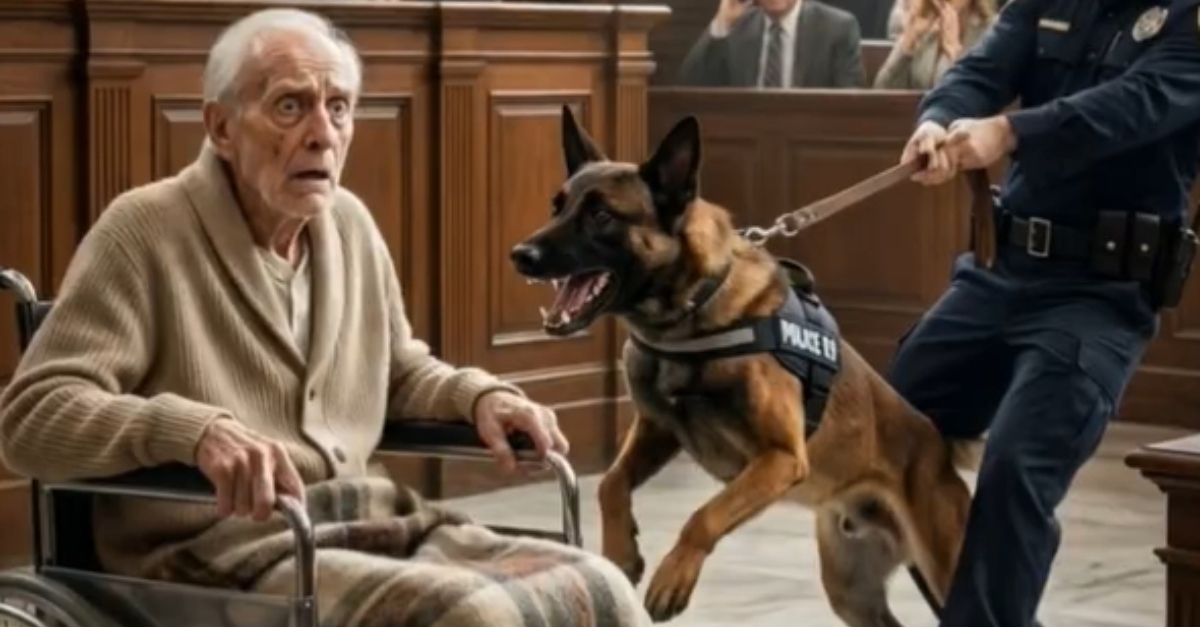
Officer Jax was more than just a police dog; he was a Belgian Malinois with a record so spotless it bordered on the legendary. For three years, he had stood at the heels of Sergeant Miller, a silent partner who moved with the precision of a Swiss watch. In the sterile, wood-paneled environment of Courtroom 4B, Jax was expected to be a decorative piece of the legal machinery, a living symbol of the law’s reach. He sat motionless as the defense presented its closing arguments for Elias Thorne, a man whose life had been tragically upended by a hit-and-run that left him confined to a motorized wheelchair. Thorne looked every bit the broken victim, his frame slumped and his voice a raspy whisper that tugged at the heartstrings of every juror in the box.
The shift happened in a heartbeat. As the bailiff stepped forward to hand a document to the judge, passing within a few feet of Thorne, Jax didn’t just growl—he detonated. The dog’s leash snapped taut as he lunged, a terrifying display of muscle and snapping jaws aimed directly at the man in the wheelchair. The gallery erupted in screams. To the onlookers, it was a grotesque betrayal: a high-profile “hero” dog suddenly snapping and trying to maul a disabled man. Miller fought to restrain the animal, his boots skidding on the polished floor, while Thorne cowered, shielding his face with trembling hands as the judge hammered his gavel for order.
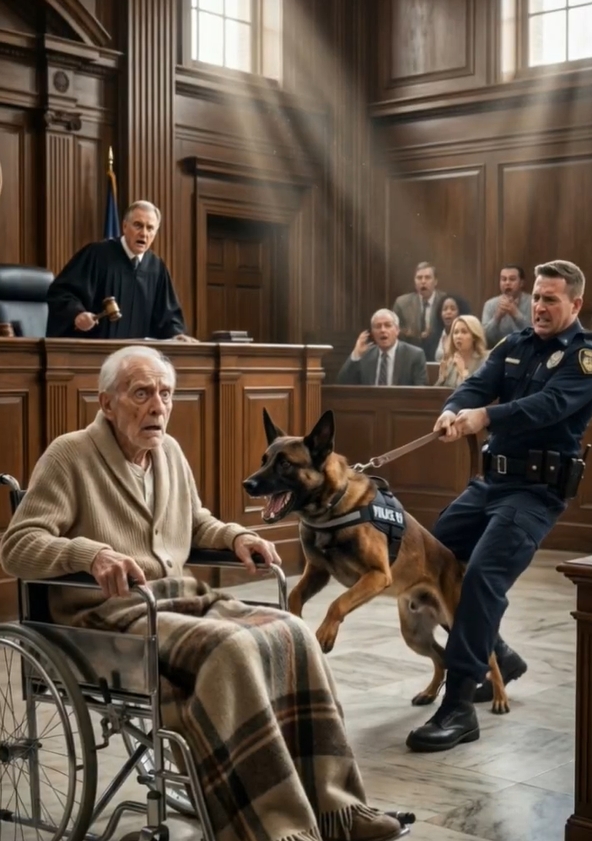
Security rushed to intervene, and Jax was dragged from the room, still straining against his collar with a focused, predatory intensity. The immediate fallout was a PR nightmare for the department. Calls for Jax to be retired—or worse—flooded the precinct, and the defense immediately moved for a mistrial, citing the extreme prejudice the “attack” had created against their client. However, Miller knew Jax better than he knew himself. A dog trained for years to distinguish between a casual bystander and a lethal threat doesn’t just “glitch” without a catalyst. While the public saw a victim, Miller remembered the way Jax’s nose had twitched, not toward Thorne’s face, but toward the base of the heavy, customized wheelchair.
Acting on a hunch that felt more like a desperate gamble, Miller requested a specialized sweep of the courtroom under the guise of “securing the premises” after the outburst. When the investigators approached Thorne in the holding room, they didn’t look at his medical records; they looked at the chair. Hidden within the reinforced frame of the motorized seat, tucked behind the battery housing, was a sophisticated compartment. It wasn’t drugs or weapons they found, but a series of cold-storage vials and encrypted drives. As it turned out, Elias Thorne wasn’t a victim of a tragic accident; he was a high-level courier for a synthetic neurotoxin ring, using his perceived frailty and the bulk of his medical equipment to bypass security checkpoints that would have flagged any able-bodied man.

The “accident” that had paralyzed him was a fabrication, a deep-cover persona supported by forged documents and a surgically implanted untraceable device that allowed him to mimic the symptoms of spinal trauma. Jax hadn’t smelled fear or disability; he had smelled the trace chemicals of the volatile compounds leaking from a microscopic seal in the chair’s hidden vault. The man who had been garnering the world’s sympathy was, in reality, a ghost in the machine of global trafficking. With the evidence seized, the “victim” dropped his facade, standing up from his chair in the interrogation room to meet the cold gaze of the detectives. Jax was fully exonerated, returning to the force not as a liability, but as the only observer in the room sharp enough to see past a masterfully crafted lie.