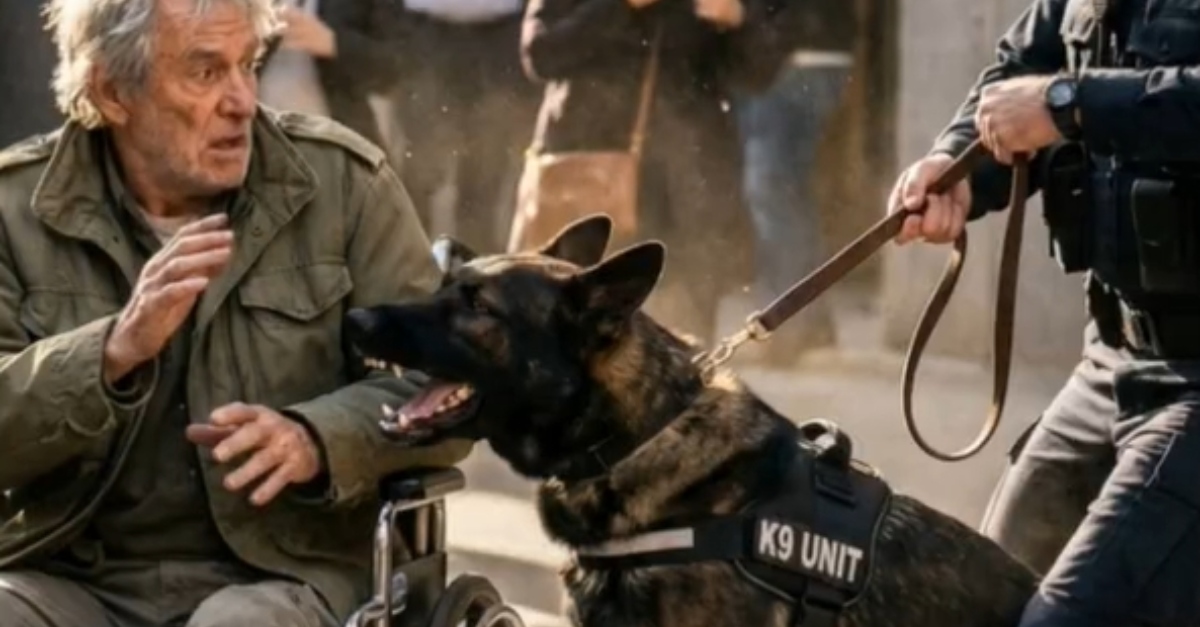
The crisp morning air in the town square was shattered not by a scream, but by the rhythmic, mechanical clicking of a wheelchair on the pavement. The man sitting in it looked like a stiff breeze might break him; his skin was a translucent parchment, and his frame was draped in an oversized woolen coat that seemed to swallow him whole. Passersby instinctively stepped aside, their faces softening into masks of pity. It was a silent, collective mourning for a stranger’s lost vitality. Even the local police officer, standing on the corner with his Belgian Malinois, softened his stance, offering a respectful nod as the frail figure approached.
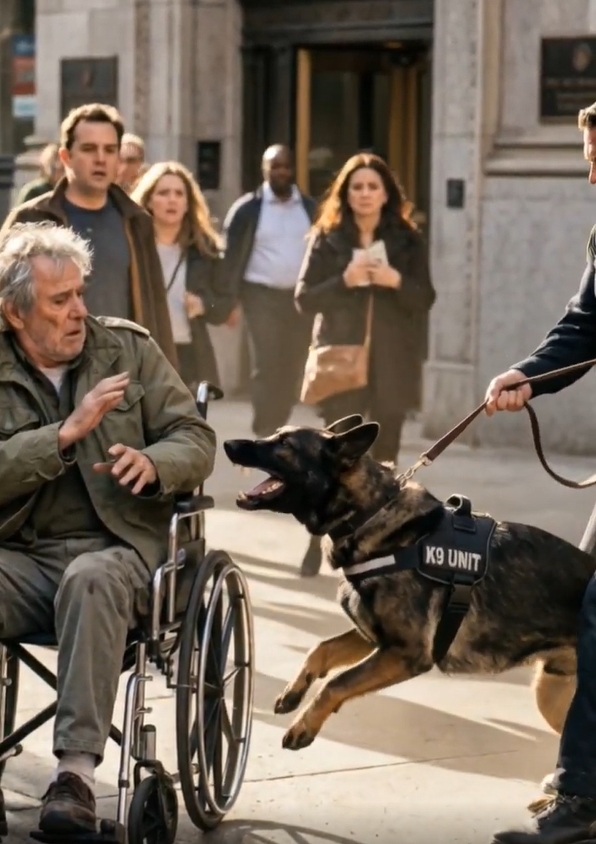
The dog, a highly trained K9 named Rex, had spent the morning like a statue, indifferent to the bustling commuters and the pigeons fluttering nearby. But as the wheelchair drew parallel to the officer’s boots, the atmosphere curdled. Rex didn’t growl; he didn’t give a warning. He exploded. The dog’s body became a coil of violent muscle, his teeth bared in a primal snarl that echoed off the surrounding brick walls. He lunged with such sudden, concentrated ferocity that the heavy leather leash groaned, pulling the officer nearly off his feet.
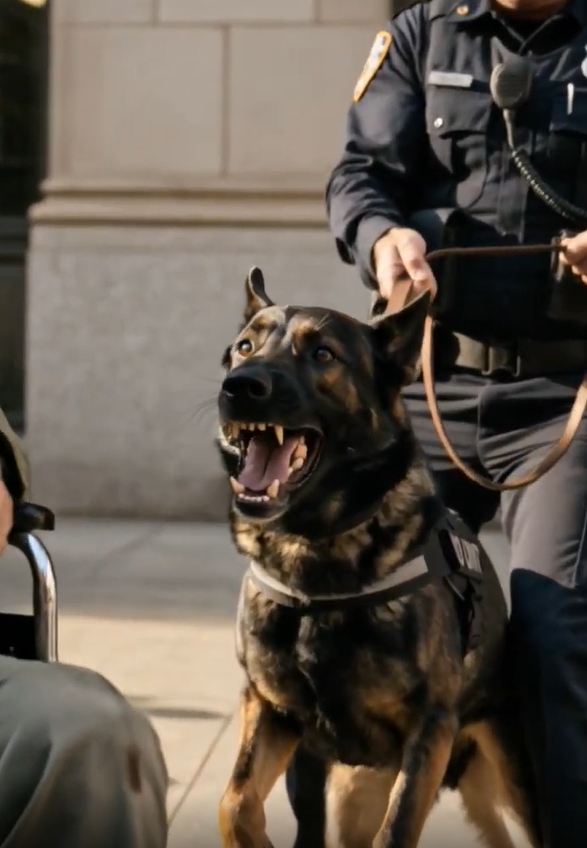
The crowd recoiled in a wave of shock and indignation. To the onlookers, this was a grotesque malfunction of a public servant—a powerful beast terrorizing a man who couldn’t even stand to defend himself. Cries of “Control your animal!” and “He’s just an old man!” rose from the sidewalk. The officer struggled to anchor himself, his heels skidding as Rex continued to snap at the air, his eyes fixed with terrifying intensity on the man in the chair. Through it all, the man remained eerily still. He didn’t flinch, didn’t cry out, and didn’t look at the dog. He simply stared straight ahead, his pale hands gripped tight on the armrests.
In that frantic moment, the officer noticed something the crowd missed. As Rex strained toward the wheelchair, the man’s hand slipped beneath the heavy wool of his coat, not in fear, but with a practiced, fluid grace that contradicted his fragile appearance. The officer’s training took over. He didn’t pull Rex back; instead, he used the dog’s momentum to pivot, blocking the path of the wheelchair and shouting for everyone to get back. The dog wasn’t reacting to a person; he was reacting to a scent—the chemical tang of adrenaline and the cold, metallic odor of a concealed weapon that had seen recent use.
The standoff lasted only seconds, though it felt like an hour. When the officer’s backup arrived and they finally forced the man to stand, the illusion of frailty vanished. Beneath the oversized coat was a tactical vest and a high-caliber pistol, still warm from a crime committed only blocks away. The “victim” was a professional who had used the town’s sympathy as a shroud, assuming no one would look twice at a broken man in a chair. He had fooled every human eye in the square, playing on their innate desire to protect the weak.
As the suspect was led away in handcuffs, walking with a steady, defiant stride that betrayed his physical ruse, a heavy silence fell over the square. The onlookers watched, their sympathy replaced by a cold, prickling sweat. They realized that their eyes had lied to them, blinded by a carefully constructed performance of vulnerability. Rex, now sitting calmly by his handler’s side, gave a single, sharp bark as if to dismiss the crowd. The predatory scent was gone, and the world was right again, leaving the townspeople to wonder how many other monsters were hiding in plain sight, waiting for someone—or something—to see past the mask.