
The damp air of the alleyway clung to Elias like a second skin, smelling of old stone and coming rain. He moved with a practiced haste, his coat billowing against the uneven walls as he navigated the shortcut he had taken a thousand times. In his rush, his gloved hand brushed against his pocket, dislodging a worn piece of cardstock. It fluttered through the golden, dusty light of the setting sun, landing facedown on the slick cobblestones. That photograph was his only tether to a life that had ended fifteen years ago—the face of his wife, Clara, whose laughter had been silenced by a fever long before the city’s skyline had grown so tall.
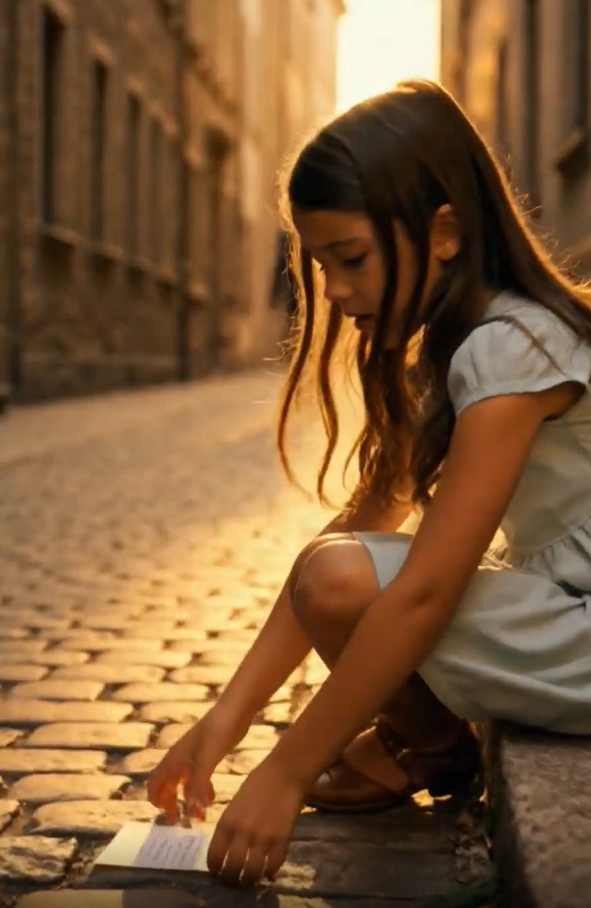
He didn’t realize it was gone until he reached the end of the passage. Turning back, he saw a small figure kneeling where he had stood moments before. A young girl, perhaps seven years old, held the photo in her small, pale hands. Her hair was the color of toasted wheat, tucked behind her ears just the way Clara used to do when she was deep in thought. Elias exhaled a shaky breath, stepping toward her with his hand outstretched, his heart hammering against his ribs at the thought of losing that precious image. “Thank you, child,” he said, his voice thick with the gravel of age and old sorrows. “That belongs to me. It’s a picture of my wife.”

The girl did not hand it over. Instead, she traced the line of Clara’s jaw with a thumb that looked impossibly familiar. She looked up, her eyes a piercing, intelligent green that mirrored the woman in the frame. “No,” she whispered, her voice steady and clear, cutting through the distant hum of the city. “This is my mother.” A cold chill, sharper than the evening breeze, raced down Elias’s spine. He knelt before her, trying to maintain a gentle expression despite the grief that threatened to boil over. “That’s impossible, little one,” he said, his eyes stinging. “She passed away many years ago. I buried her myself in the garden beneath the willow tree.”
The child didn’t flinch. She met his gaze with a haunting certainty that felt older than her years, a look of recognition that defied the logic of the world. “She didn’t leave,” the girl insisted, leaning in closer until Elias could see the tiny fleck of amber in her left iris—the exact mark Clara had carried. “She told me you would be coming this way. She said she was tired of being a memory and decided to start again. She’s waiting at the bakery on the corner, buying the cinnamon bread you like.” She pressed the photograph into his palm, her skin warm and vibrant, a stark contrast to the cold paper.
Elias stared at the photo, then at the girl, his mind reeling between madness and a sliver of impossible hope. He found himself running, the girl’s small hand gripping his as she led him out of the shadows and toward the light of the main street. The bell of the corner bakery chimed as they burst through the door, the scent of yeast and sugar wrapping around them like a shroud. Standing at the counter was a woman with her back to them, wearing a coat the color of autumn leaves.
When she turned, the world seemed to click into a new, terrifyingly beautiful alignment. It was Clara—not a ghost, not a memory, but a woman in the prime of her life, holding a warm loaf of bread. She didn’t look surprised; she simply smiled, that same crooked, lopsided grin that had been the light of his youth. “You’re late, Elias,” she said softly. He realized then that time was not a straight line, but a circle, and somehow, through a miracle he would never fully understand, his grief had finally folded back into joy. He reached out, his fingers brushing her sleeve, finding not the dust of the grave, but the solid, breathing reality of a life reclaimed.